
Australia Take First-Innings Lead After Dramatic Day in Cape Town Test
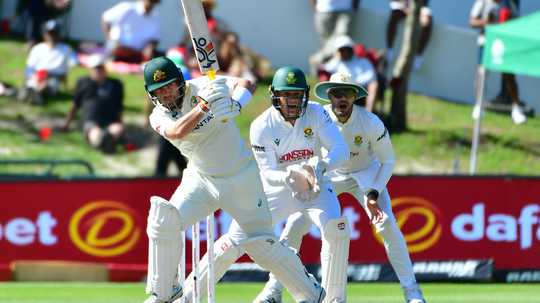
Australia seized the advantage in the final Test in Cape Town after a day of shifting momentum ended with the visitors edging past South Africa’s first-innings total. A late, unbroken century partnership between Josh Inglis and Alex Carey transformed a competitive contest into a promising position for Australia, who reached 330 for four in reply to South Africa’s 329.
Inglis finished the day unbeaten on 85, while Carey was not out on 50. Their stand carried Australia through a tense final session and secured a one-run lead with only two deliveries remaining. Earlier, Matt Renshaw and Cameron Green had also made half-centuries, ensuring that almost the entire Australian batting order contributed. Marnus Labuschagne was the exception, falling for a duck.
The result was a day of cricket defined by partnerships and sudden reversals. South Africa appeared to have regained control twice, but Australia repeatedly rebuilt, with Inglis and Carey delivering the most decisive response. The latest cricket prediction for the Test will now depend heavily on whether Australia can extend their advantage and how effectively South Africa respond with the bat.
Australia Start Confidently Before Harmer Strikes Twice
Renshaw, promoted to open the innings, got off the mark in the first over by steering a delivery past gully. Travis Head settled quickly at the other end, finding the boundary off Kagiso Rabada as Australia looked to make the most of the new ball.
Rabada and Marco Jansen, South Africa’s leading pace options, initially struggled to find a breakthrough. Gerald Coetzee, playing his first Test in nearly two years, brought extra pace and tested the Australian batters, but Head responded with consecutive boundaries. The pair’s positive start took them past a half-century partnership and gave the visitors early momentum.
South Africa’s answer came through spin. Simon Harmer was introduced after the drinks break, and his first delivery brought an immediate reward: Head chopped the ball onto his stumps and departed for 41. Harmer struck again in the same over, tempting Labuschagne into an edge that carried to slip. Australia had lost two wickets in quick succession, and South Africa had turned a steady beginning into a sudden challenge.
Green helped calm the innings, finding the boundary against Wiaan Mulder and gradually building confidence. He and Renshaw saw Australia through to the interval, with Green finishing the morning session by adding another four. The teams went to lunch with the contest finely balanced.
Renshaw and Green Build a Crucial Partnership
The afternoon session began with both batters continuing to score freely. Renshaw and Green each struck a boundary off Rabada, before Green took the attack to the fast bowler. He pulled two consecutive deliveries for sixes and followed them with a four, shifting pressure back onto South Africa.
The aggressive passage helped both Australians reach their half-centuries in the same over. More importantly, they combined for a century stand for the third wicket, giving Australia the platform it needed after Harmer’s double strike. Their partnership was built through a mix of controlled defence and timely attacking shots, and for a period South Africa struggled to disrupt their rhythm.
Jansen, however, changed the mood again. Returning to the attack, he removed Renshaw after the batter attempted to ramp a short ball over the wicketkeeper and edged it behind. Green followed soon after, driving at a delivery and sending an edge to the lone slip. Two established batters were gone, and South Africa had reclaimed the initiative just before tea.
Those wickets underlined how quickly the match could turn. Australia had appeared comfortable, but Jansen’s disciplined spell exposed the risk of trying to force the pace against a bowler capable of generating bounce and movement. The visitors went into the final session needing another partnership to prevent South Africa from taking control.
Inglis and Carey Shift the Contest
Inglis and Carey began cautiously, aware that a collapse could leave Australia trailing by a significant margin. They focused on seeing off the threat before expanding their range, and their measured approach paid off. Once they had negotiated the early overs and reached the drinks break without losing a wicket, both batters began to play with greater freedom.
Inglis provided the spark, advancing down the pitch to Harmer and launching the spinner for six. That shot opened up the scoring, and boundaries followed as the partnership grew. The pair combined patience with selective aggression, refusing to let South Africa’s earlier breakthroughs dictate the final session.
As the stand passed 100, South Africa took the new ball as soon as it became available, hoping pace and fresh energy would produce a late wicket. Instead, Inglis and Carey remained composed. Inglis struck consecutive boundaries in the penultimate over, and Carey added another to bring up his half-century. Their partnership not only steadied Australia but also carried the visitors beyond South Africa’s total at the close.
What the First-Innings Lead Means
Australia’s four half-centuries—from Renshaw, Green, Inglis and Carey—showed the value of contributions across the batting order. The innings was not built around one dominant knock; instead, several partnerships helped absorb pressure and keep the scoreboard moving. Inglis’s unbeaten 85 was particularly important, while Carey’s calm presence ensured the visitors finished the day with control.
For South Africa, Jansen’s two wickets and Harmer’s double strike demonstrated the effectiveness of their bowling attack when they found the right lengths. Yet the hosts will be frustrated that neither breakthrough burst led to a sustained collapse. Their challenge now is to dismiss the remaining Australian batters quickly, limit the first-innings deficit and avoid allowing the lead to grow into a decisive one.
Brief scores: Australia 330/4 (Josh Inglis 85*, Matt Renshaw 74, Cameron Green 65; Marco Jansen 2-37) lead South Africa 329 by one run.
The next phase will shape the match’s direction. If Australia can add valuable runs and build a substantial lead, the pressure will shift firmly onto South Africa’s batting lineup. If the home side strikes early, the contest could return to an even footing. For now, Australia hold the edge after an absorbing day in Cape Town—and the most compelling prediction is that the match remains wide open, with the next session likely to be crucial.