
Ethan Nwaneri’s Early Red-Card Scare Turns Into a Yellow in Dortmund’s Match at Union Berlin
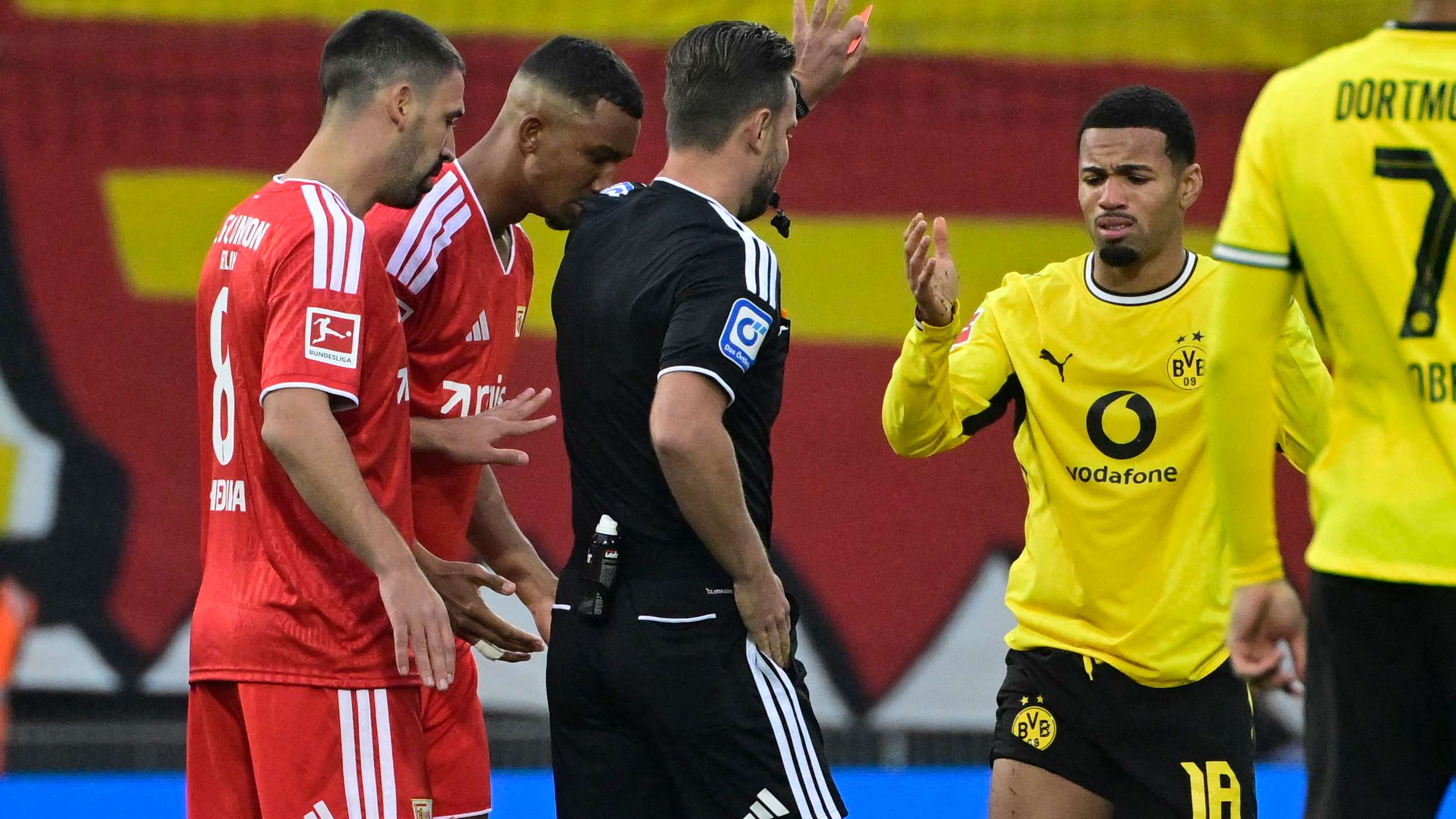
Borussia Dortmund’s away match against Union Berlin began with an extraordinary moment when Ethan Nwaneri appeared to be sent off just seconds after kick-off. The young attacker was shown a red card for a forceful challenge on Tom Rothe, only for referee Daniel Schlager to immediately withdraw it and display a yellow instead.
The unusual mix-up briefly raised questions about whether Dortmund would have to play almost the entire game with 10 men. Instead, the correction left Nwaneri on the pitch and gave the incident an unexpected place in the early story of the Bundesliga fixture at the Alte Försterei.
A dramatic challenge in the opening seconds
Nwaneri’s tackle came midway inside Union Berlin’s half, as Rothe moved to advance the ball. The Dortmund player slid in from the side at speed, narrowly failing to win possession and making contact with Rothe’s right ankle with the sole of his left boot.
Schlager reacted quickly, approaching the scene and raising a red card. But the referee then waved that decision away with his left hand before showing Nwaneri a yellow card with his right. The change happened almost immediately, making it clear that the first gesture had not been the final disciplinary decision.
Dortmund coach Niko Kovac appeared to smile on the touchline as the situation was resolved. For the visitors, the correction was significant: an actual dismissal would have forced them to reorganise their game plan before the contest had properly begun.
Why the tackle drew concern
Although Nwaneri avoided a sending-off, the challenge was close enough to prompt concern from those watching. He seemed to miss the ball and caught Rothe around the ankle, with the raised sole of his boot adding to the risk of the contact. In football, a referee’s decision on a tackle often depends not only on whether a player touches the ball, but also on the speed, force and point of impact.
The incident could have had a different outcome if the contact had landed higher on Rothe’s leg. A tackle with similar force that strikes above the ankle may be judged more dangerous, potentially turning a yellow-card offence into a red-card one. In this case, Schlager’s final decision was to caution Nwaneri, but the moment served as a reminder of how quickly a mistimed challenge can change a match.
For Dortmund, the episode also highlighted the fine margins involved in defending and pressing aggressively. Young attackers are often expected to compete hard when possession is contested, but arriving late or sliding in at speed can leave little room for error. Nwaneri’s challenge was an early warning that intensity must be balanced with control.
Kobel questions the decision to make the challenge
Dortmund goalkeeper Gregor Kobel admitted that the referee’s initial gesture surprised him. Speaking to Sky, the Swiss international said: “I thought I was seeing things.” His reaction reflected the confusion the apparent red card caused before Schlager clarified the decision.
Kobel also offered a measured criticism of his young team-mate’s tackle. He described the foul as being “right on the borderline” and questioned whether Nwaneri needed to commit to the challenge in that way. His comments pointed to a practical concern for Dortmund: a reckless tackle can put both the opponent and the team at risk, especially when a dismissal could leave the side short-handed.
The goalkeeper’s response was not simply about the referee’s decision. It also underlined the responsibility players have to assess a challenge before committing. In a high-tempo match, a split-second decision can bring a booking, a serious injury or a numerical disadvantage that shapes the rest of the game.
Nwaneri’s growing role at Dortmund
Nwaneri joined Dortmund on loan from Arsenal during the summer, arriving as the German club sought to strengthen its attacking options. The move became more important after new signing Giannis Konstantelias suffered a cruciate ligament injury on the opening matchday, reducing the team’s choices in the forward areas.
The versatile, left-footed Englishman was making his fifth Bundesliga appearance in Berlin, alongside two appearances in the Champions League. Those opportunities offer him a chance to gain experience in a new league and adapt to Dortmund’s demands, while also increasing the attention on his performances.
At 19, Nwaneri is still developing, and his ability to contribute across attacking positions could make him useful over a demanding season. The Union Berlin incident, however, showed that learning the rhythm of a new competition involves more than finding space and creating chances. It also means understanding how referees interpret physical challenges and how quickly discipline can become a decisive issue.
What the incident means for Dortmund
The overturned red card did not end Nwaneri’s involvement after the opening seconds, but it gave Dortmund an immediate tactical and disciplinary concern to manage. A player on a yellow card may need to approach later challenges more carefully, particularly against an opponent who can exploit space or draw fouls.
For Kovac, the episode was a reminder that discipline can be just as important as attacking quality. Dortmund’s schedule includes a Champions League fixture against FC Augsburg on 21 October 2026, followed by another Bundesliga meeting with Union Berlin on 24 October. Managing player fitness, confidence and availability across those games will be part of the wider challenge.
The incident also creates an obvious talking point for supporters considering a football prediction for Dortmund’s next match. Nwaneri’s attacking promise and growing experience may strengthen the team, but his early booking in Berlin highlights the importance of composure. Any prediction should account for more than individual talent: team selection, discipline, injuries and the pace of the fixture can all influence the outcome.
Ultimately, the opening-minute confusion was brief, but the tackle itself was a serious moment. Nwaneri escaped with a yellow card after Schlager corrected the initial signal, while Kobel made clear that the challenge had been unnecessarily risky. For Dortmund’s young loanee, the episode may prove a useful lesson: in elite football, commitment matters, but timing and control can matter just as much.