
Frenkie de Jong targets Barcelona comeback after injury return in El Clásico
Frenkie de Jong has made it clear that he is not prepared to drift to the margins of Barcelona’s plans. After returning from a serious knee injury in last Sunday’s El Clásico against Real Madrid, the Dutch midfielder is focused on building his fitness, earning more minutes and reclaiming a regular place in Hansi Flick’s side.
The 29-year-old’s brief appearance offered an encouraging sign for Barcelona. Introduced for Fermín López, De Jong played 16 minutes in an unfamiliar attacking-midfield role and looked composed despite the intensity of the occasion. His return is not yet a full comeback, but it gives Flick another option at a crucial point in the season.
De Jong says he is ready to compete for minutes
Speaking to Dutch broadcaster Ziggo Sport, De Jong acknowledged that his recovery must be handled carefully. However, he was equally direct about his ambition to play regularly again.
“I have never spent a long time on the bench, and I don’t want to be forced to do so this season,” he said. “I am now fully fit and getting stronger day by day, and I hope to get more playing minutes soon.”
He added that he understands the need for a gradual return, but wants to work his way back into the starting XI as quickly as possible. The comments underline a familiar part of De Jong’s character: he has confidence in his ability and expects to compete for a meaningful role rather than simply accept a place in the squad.
That determination will be tested. Barcelona’s midfield is crowded, and Flick has several players capable of filling central positions. De Jong’s challenge is not only to regain match sharpness after his layoff, but also to show where he can offer the greatest value within the coach’s evolving system.
From World Cup injury to a cautious return
De Jong’s absence began after he tore the medial collateral ligament in his right knee while representing the Netherlands at the 2026 World Cup. The injury interrupted his campaign and required a period of rehabilitation before he could resume full training.
Once he had recovered sufficiently, Flick included him in the squad for Barcelona’s La Liga meeting with Real Betis and their Champions League fixture against Paris Saint-Germain. De Jong did not feature in either match, as the club continued to manage his return. His appearance against Real Madrid was the first competitive action of this comeback phase.
For a player whose game depends on mobility, balance and confidence in tight spaces, returning from a knee injury requires more than simply being cleared to play. Barcelona will want to increase his workload carefully, while De Jong will need time to rediscover the rhythm that allows him to dictate play under pressure.
Flick welcomes the midfielder’s quality on the ball
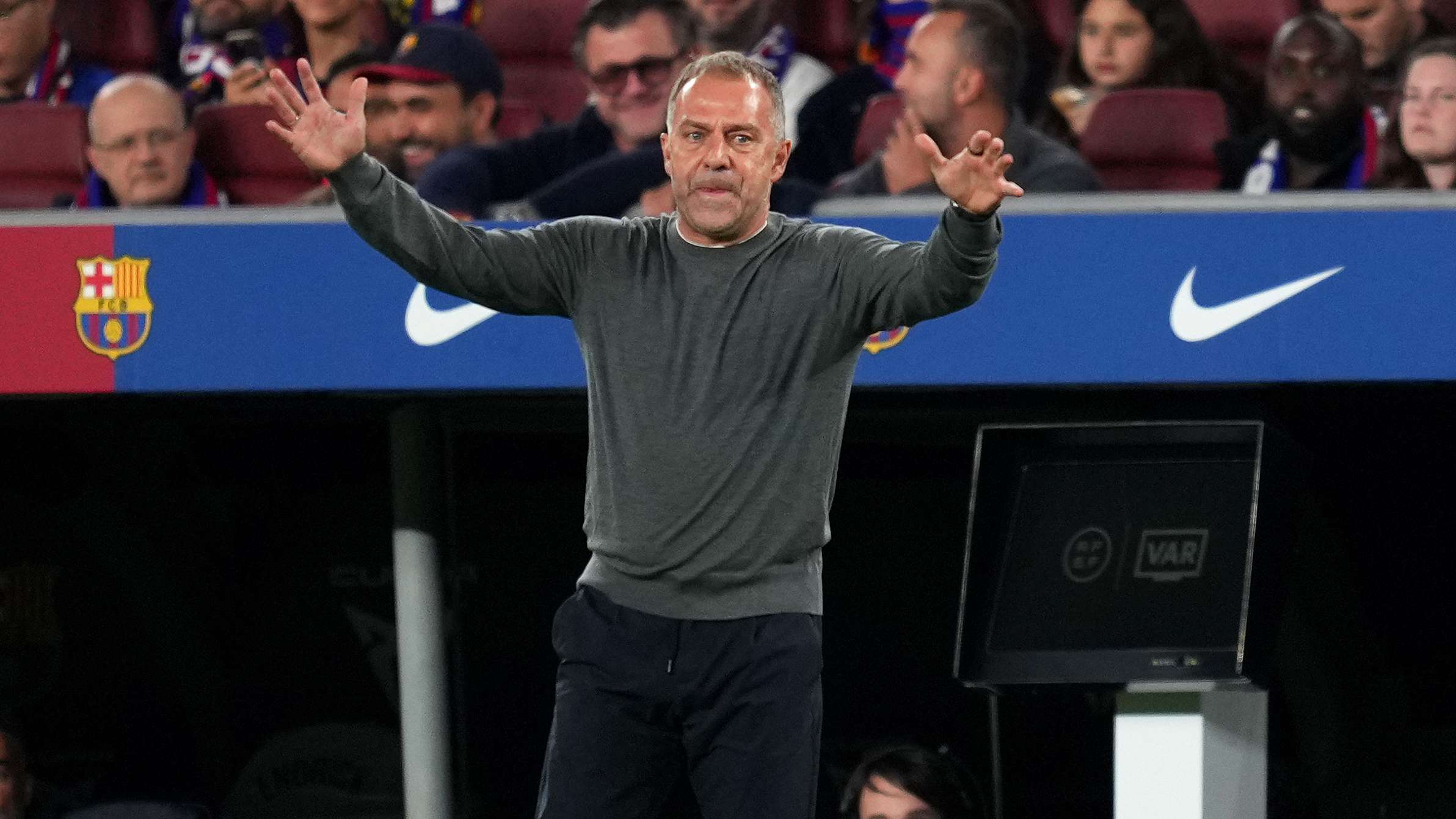
Flick praised De Jong’s work in training and the control he can bring to Barcelona’s midfield. The coach said the Dutchman had trained very well, described him as a source of strength in possession and stressed that getting him onto the pitch for a few minutes was important.
That approval matters because De Jong’s role may not be limited to his preferred position. Barcelona’s midfield structure has often relied on a double pivot, where two players share defensive responsibilities and help progress the ball. Competition for those places is intense, with Pedri, Rodri, Gavi and Marc Bernal all in the picture, depending on availability, form and tactical needs.
De Jong has experience operating deeper, where his ability to carry the ball through midfield and resist pressure can help Barcelona move from defence into attack. Yet his cameo against Madrid suggested Flick may also consider him further forward, at least while the team’s options in attacking midfield are affected by injuries.
Could attacking midfield provide a new route?
Fermín López has been occupying an advanced midfield role, while Dani Olmo’s injury has created uncertainty around Barcelona’s depth in that area. De Jong is not naturally an attacking midfielder, but his technical ability, awareness and capacity to link play could make him a useful alternative.
Playing higher up the pitch would present different demands. Rather than primarily helping Barcelona build from deep, De Jong would need to find space between the opposition’s lines, combine quickly with forwards and contribute closer to goal. His brief appearance against Real Madrid was not enough to establish whether this could become a regular role, but it gave Flick a chance to assess the option in a high-pressure setting.
The tactical flexibility could benefit both player and club. Barcelona need reliable depth across a demanding schedule, and De Jong’s return gives the coach more combinations to consider. For the midfielder, being willing to adapt may be the quickest way to regain momentum while competition for the deeper positions remains fierce.
What to watch in Barcelona’s next matches
Barcelona’s upcoming fixtures will provide an early test of how quickly De Jong can move from short appearances to a larger contribution. His minutes are likely to depend on his response to training, the team’s physical demands and Flick’s assessment of the balance in midfield. A gradual increase would allow the club to protect his recovery while giving him opportunities to rebuild match fitness.
For supporters following the football season, De Jong’s return is also a significant subplot in Barcelona’s campaign. When fully fit, he can help the side retain possession, escape pressure and connect defensive phases with attacking moves. Those qualities could be particularly valuable against opponents who press aggressively or defend in compact shapes.
Any prediction about his eventual role should remain cautious. One strong cameo does not guarantee a starting place, especially in a squad with several talented midfielders. But De Jong’s determination, Flick’s positive assessment and the opening created by Olmo’s absence give him a credible path back into the rotation.
The immediate objective is straightforward: stay fit, earn more minutes and demonstrate that he can influence matches again. De Jong has returned to the pitch, but the larger challenge is still ahead. If he continues to progress, Barcelona may gain not only a key midfielder back but also a versatile option capable of adapting to the team’s changing needs.