
Sina Movahed Wins Titled Tuesday After Dramatic Final-Round Finish
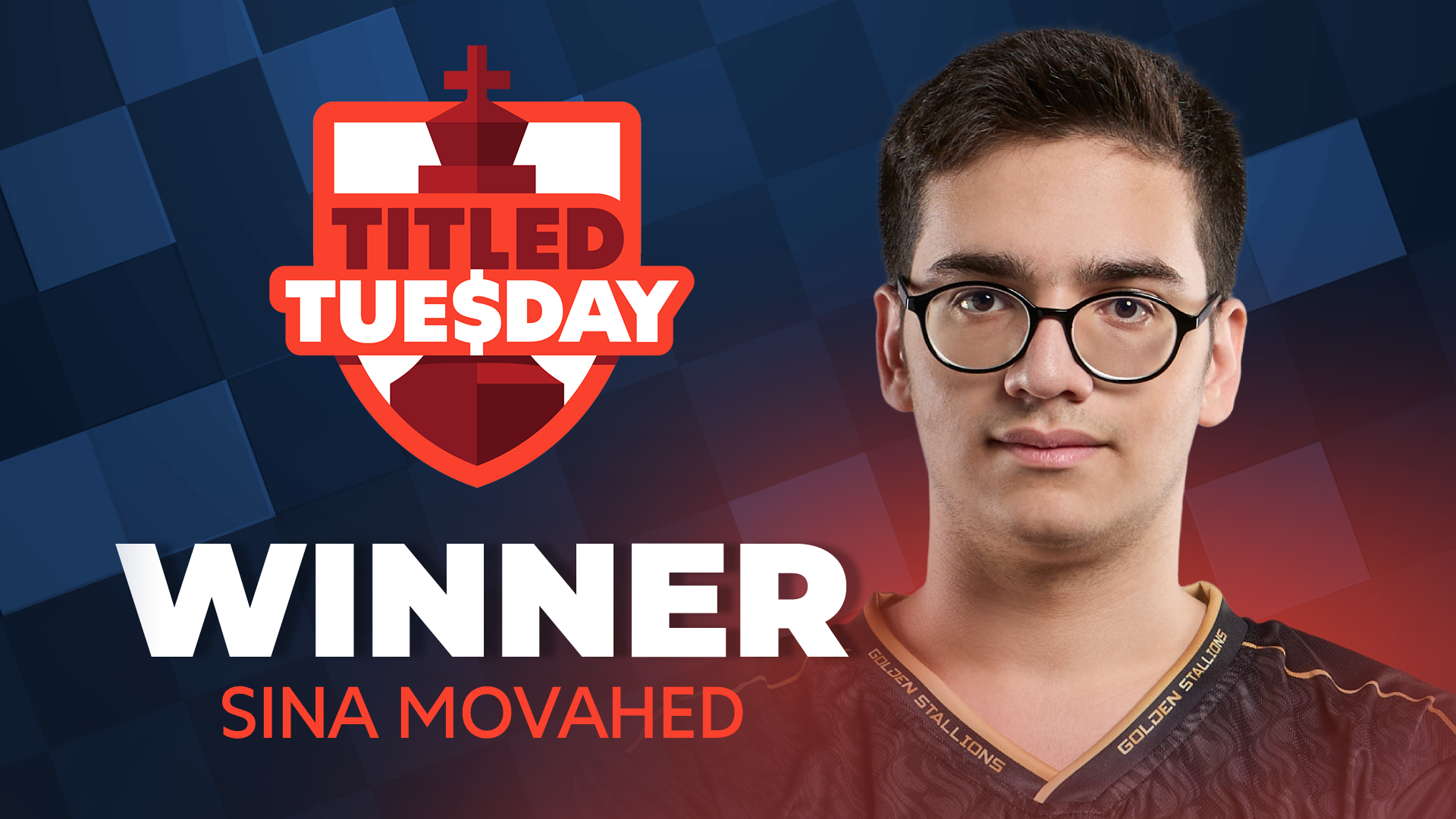
Grandmaster Sina Movahed claimed first place in the November 10 edition of Chess.com’s Titled Tuesday, edging GM Denis Lazavik on tiebreaks after both players finished with 9.5 points. The result capped a tense tournament shaped by shifting leaders, high-pressure endgames and a decisive final round.
Movahed’s victory was his fourth Titled Tuesday title of the year, bringing him level with GM Hikaru Nakamura for the most wins in the weekly event in 2026. The result also strengthened his position in the Champions Chess Tour (CCT) standings, where he moved into second place behind Nakamura. Lazavik sits third.
The tournament offered a preview of several players expected to feature prominently in the upcoming Speed Chess Championship (SCC). While the SCC lineup has already been confirmed, Titled Tuesday results remain important for the CCT race, adding points to players’ totals as they pursue qualification and position in the tour standings.
Final-round drama decides the title
Movahed and Lazavik entered the last round among a small group still in contention for first. Movahed faced fellow Iranian GM Parham Maghsoodloo, while Lazavik took White against GM Sam Sevian. The outcome of both games would determine the tournament winner.
Sevian had taken the outright lead after a crucial victory over Maghsoodloo in the previous round. Their game had followed a pattern of patient pressure: Maghsoodloo had earlier defeated Nakamura in an endgame while playing Black, but Sevian responded with a composed performance of his own. The win gave Sevian a chance to secure the tournament with a final-round victory.
That opportunity became less certain when Sevian played 12.Nf5, a move that looked active but allowed Lazavik to respond with 12…Qa5. Sevian managed to stay in the game, but the position remained uncomfortable. On the other board, Movahed gradually built an advantage against Maghsoodloo. A pair of awkward moves, 18…Nf5 and 19…Rf8, left Maghsoodloo facing additional tactical problems, and Movahed converted his edge to win.
With Movahed’s game finished, the pressure shifted to Lazavik and Sevian. Lazavik recovered the advantage he had previously let slip, and the game entered a time scramble. He handled the clock pressure effectively, converting the position into a win. That result lifted Lazavik to the same score as Movahed, but Movahed took the title on the first tiebreak, 72 to 70.
Maghsoodloo and Tabatabaei make early runs
Movahed was among 16 players who opened with four wins from four rounds, while Lazavik began with two draws and stood on three points. The slower start did not prevent Lazavik from catching the leaders, though it may have affected the tiebreak calculation that ultimately separated the top two.
Movahed’s tournament was not flawless. He lost to a grandmaster in round five, and a draw in round seven was his only other setback. His ability to recover from the defeat proved decisive as the field tightened in the closing rounds.
Another major storyline belonged to GM Parham Maghsoodloo, who emerged as the leading threat to the tournament’s $6,000 perfect-score bounty. Maghsoodloo reached seven points from seven games, producing several convincing wins along the way. His round-five victory over GM Amin Tabatabaei was especially notable: tactical play in the middle game gave him a clear advantage, which he then converted without allowing his opponent a meaningful chance to recover.
Tabatabaei later returned to the spotlight with a round-seven win over another grandmaster. Despite falling behind on the clock early, he managed his time well, turned the game around and demonstrated superior endgame technique. His run ended in round eight, when Maghsoodloo took over the lead after a decisive clash between two of Iran’s strongest young players.
Maghsoodloo then faced Nakamura with the Black pieces and produced one of the tournament’s standout performances. He outplayed the former world blitz champion in an endgame while maintaining a clock advantage. But his bid for first place stalled when Sevian beat him in their next encounter, setting up the dramatic final round.
Top finishers and prize winners
Behind the two leaders, GM Dmitry Andreikin finished third with nine points, earning $1,000. GM Alexey Sarana took fourth, followed by GM Jeffery Xiong and Sevian. Nakamura and GM Alexander Grischuk also scored nine points, placing seventh and eighth, respectively.
Maghsoodloo finished ninth with 8.5 points, while GM Dmitrij Kollars completed the top 10. Movahed received $2,500 for first place, and Lazavik earned $1,500 for second. The perfect-score bounty went unclaimed, so it will grow by $250 for the next week, in line with the tournament’s rules.
Special prizes recognized performances across different groups. WIM Margarita Potapova won the women’s prize, GM Gata Kamsky was the top senior, and GM Andy Woodward earned the top youth award. IM Frederick Gordon was the highest-finishing non-grandmaster, while FM Dincer Tasdogen led the non-IM category. Woodward’s result also highlighted the continued impact of young players in elite online chess events.
CCT standings continue to take shape
With the SCC and Chess.com Open still to come, the current CCT leaderboard reflects Titled Tuesday results alone. Nakamura leads with 38 points, followed by Movahed on 30 and Lazavik on 25. Andreikin is fourth with 24, while GM Alireza Firouzja has 21. Hans Niemann, Wesley So and Sarana are among the other players in the top 10.
Future performances at the SCC and Chess.com Open will add to the standings, but strong finishes in those events do not automatically guarantee a place beyond the points earned. That makes every weekly Titled Tuesday especially valuable for players trying to improve their tour position before the larger competitions begin.
Titled Tuesday is Chess.com’s regular online tournament for titled players, bringing together grandmasters, international masters and other competitors from around the world. The November 10 event once again showed why the fast-paced chess series can be so difficult to predict: a tournament leader can change in a single round, and even a shared final score may not be enough to claim the trophy.