
Carlsen Leads Total Chess World Championship Pilot After Blitz Tiebreaker
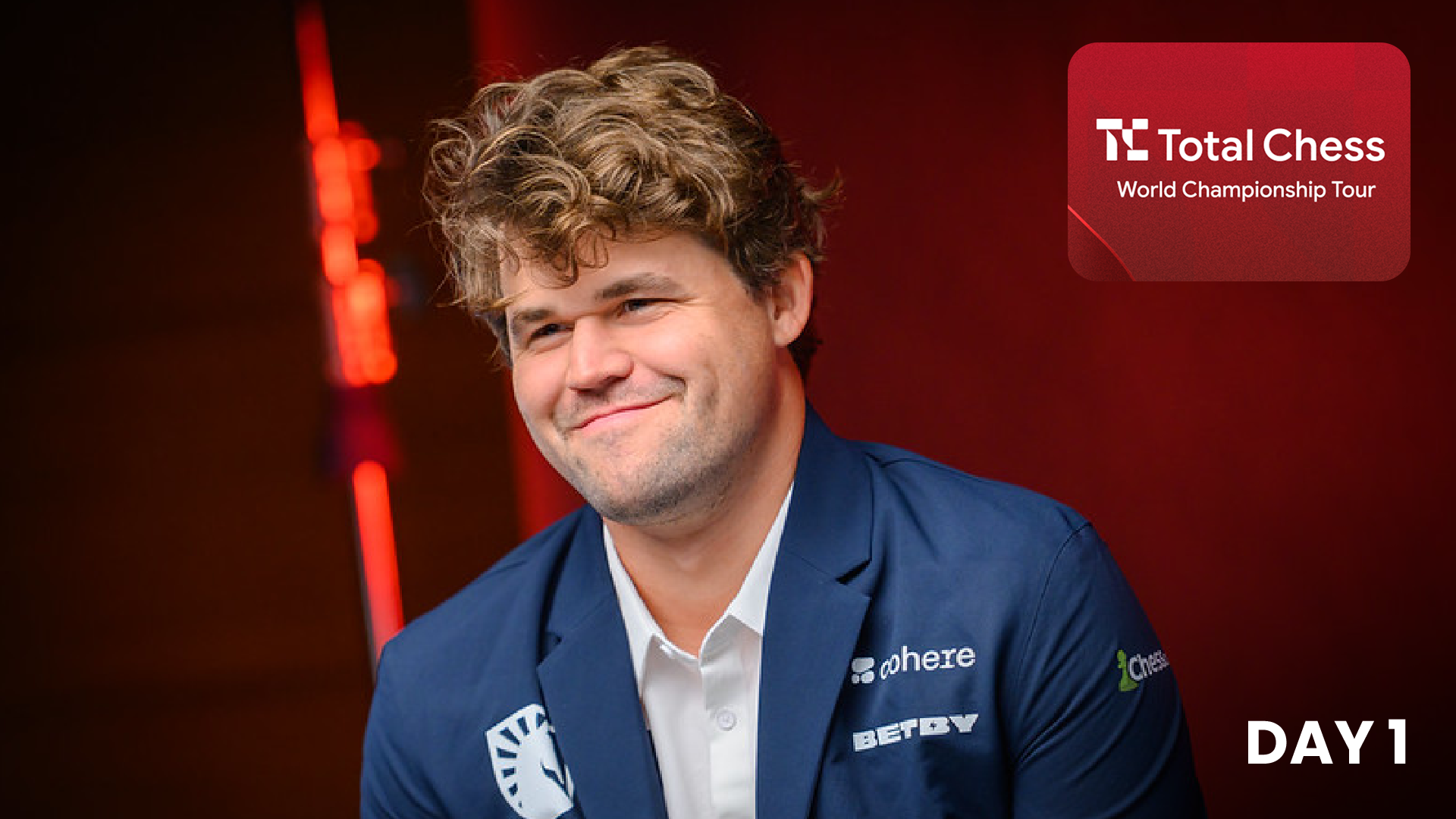
Magnus Carlsen has made a strong opening statement at the Total Chess World Championship Tour Pilot 2026, finishing first in the opening nine-round blitz tiebreaker with 7 points from 9 games. Maxime Vachier-Lagrave followed in second place with 6.5 points, while the third-place finisher scored 6 points.
The standings provide an early measure of form—and a tiebreak advantage—as the 24-player field moves into the group stage. But the blitz results are only the first chapter of a ten-day competition designed to test players across blitz, rapid, and fast classical chess.
Rounds one and two of the group stage are scheduled for Wednesday, November 11, beginning at 9 a.m. ET, 15:00 CET, and 7:30 p.m. IST. The games will use a 45+30 time control, giving players substantially more time than they had in the opening blitz event.
A New Kind of World Championship
The Total Chess World Championship is FIDE’s attempt to recognize one player’s ability across three distinct forms of the game. Instead of awarding separate titles for classical, rapid, and blitz chess, the competition is intended to produce a single FIDE World Combined Champion.
The idea has been compared to a sporting triathlon: success depends not on excelling in one discipline alone, but on adapting to different demands. Blitz rewards quick pattern recognition and nerve; rapid chess gives players more room to calculate; and fast classical chess places greater emphasis on sustained strategic judgment.
The 2026 event is a pilot, with the format serving as a trial ahead of the planned championship tour in 2027. Under the proposed structure, four tournaments will be held each year, with four qualifiers advancing to a Grand Final. Each tour event is expected to feature 24 players. FIDE may adjust the rules after reviewing the pilot, so the current competition also offers a first look at how a combined chess title could work in practice.
How the Tournament Format Works
Blitz tiebreaker: a fast start with lasting consequences
Every event begins with a nine-round Swiss blitz tournament. All 24 players compete at a time control of three minutes per player, with a two-second increment per move, commonly written as 3+2.
The blitz stage does not determine the overall champion, but it is more than a warm-up. Its standings will be used to break ties in the group stage and also influence seeding in the knockout rounds. A strong result can therefore provide a useful advantage later, especially if players finish level on points.
Group stage: ten games against five opponents
The 24 participants are divided into four groups of six. The groups were drawn at the opening ceremony, with the top four players by standard rating placed in separate groups. Each group plays a double round-robin, meaning every competitor faces each of the other five players twice.
The group stage lasts five days, with two games per player each day, for a total of ten games. The time control is 45 minutes per player, plus a 30-second increment from the first move. This “fast classical” format is intended to create a more thoughtful contest than rapid or blitz while keeping the event moving at a broadcast-friendly pace.
Scoring also differs from traditional chess tournaments: a win earns three points, a draw one, and a loss zero. The system places extra value on winning rather than settling for a draw, potentially encouraging more ambitious play. If players are tied, their blitz tiebreaker results come into consideration.
Knockout brackets combine all three time controls
After the group stage, players are ranked within their groups. Group winners enter the top knockout bracket, second-place finishers enter the next bracket, and the remaining players are assigned to lower brackets according to their group results. Blitz rankings help determine the semifinal pairings within each bracket.
Knockout matches unfold over two days and combine four blitz games, two rapid games, and one fast classical game each day. The scoring weights the formats differently: a blitz win is worth one point, a rapid win four points, and a fast classical win eight points. Draws are worth half the points available for a win in each format.
There is an unusual twist: each day is treated as a separate match. If one player wins on day one and the other wins on day two, the overall contest is tied, regardless of the margins. An Armageddon game then decides the winner. The player who won the first day chooses a color; White receives ten minutes, Black seven, with a one-second increment beginning on move 41.
Each bracket includes semifinals, a final, and a third-place match. The winner of the top bracket claims the event and earns 30 tour points. The winner of the second bracket receives 20, with lower brackets offering progressively fewer points.
Carlsen and Vachier-Lagrave Set the Early Pace
Carlsen’s unbeaten 7/9 score gave him the best start, although the standings should not be mistaken for a prediction of the final result. The Norwegian recorded five wins and four draws, showing both his tactical sharpness and ability to recover when positions became uncomfortable.
One of his most dramatic games came against Richard Rapport. Rapport had already won his first-round game and then built a promising position with Black against Carlsen in a King’s Indian Defense. Carlsen survived the pressure and turned the game around during the time scramble, a reminder of how quickly momentum can shift in blitz chess.
Carlsen also demonstrated his practical judgment in a game against Arjun Erigaisi. When his opponent’s rook move appeared to threaten a pawn on h2, Carlsen recognized that the threat was not dangerous and captured a knight instead. In the final round, he converted a pawn-up endgame that could have been held with accurate defense, securing the point needed to finish alone at the top.
Vachier-Lagrave was Carlsen’s closest challenger, scoring 6.5 points and spending part of the event sharing or holding the lead outright. The French grandmaster’s run included victories over several elite opponents, including Ian Nepomniachtchi. His only loss came against Arjun.
Vachier-Lagrave’s attacking win over Nepomniachtchi was among the day’s most compelling games. Playing Black in a Rossolimo Sicilian, he sacrificed a knight temporarily to open lines toward the king. His bishops then became powerful attacking pieces, illustrating how tactical risk-taking can be especially effective under a short time control.
What Comes Next
The blitz tiebreaker has established an initial hierarchy and given the leading players a potential edge in future tie situations. The real test begins in the group stage, where ten longer games will reward consistency, preparation, and the ability to manage energy across several days.
With Carlsen and Vachier-Lagrave already in form, attention now turns to whether they can carry that momentum into fast classical chess—and how the tournament’s three-point win system will shape the standings. The Total Chess pilot is not only a contest for tour points; it is also a live experiment in whether one championship can fairly measure excellence across chess’s most important time controls.
The 2026 pilot is being held November 10–21 at the Anantara New York Palace Hotel in Budapest, Hungary. Games and event coverage are available through the tournament’s official chess platforms, with live streaming expected from the group stage onward.