
South Africa Set Australia a 288-Run Target in Dramatic Cape Town Test
South Africa and Australia are heading towards a tense final day in Cape Town after Ryan Rickelton and Wiaan Mulder produced a determined batting fightback to put the hosts in control. Their long resistance, built on patience and careful shot selection against a deteriorating pitch, transformed the contest and left Australia needing to chase 288 runs to win the Test.
The match has swung repeatedly, making any cricket prediction for the final day difficult. Australia still have a chance, but the surface is increasingly challenging: the ball is turning sharply in places, bouncing unpredictably and occasionally keeping low. South Africa, meanwhile, have enough runs on the board to apply pressure from the outset.
Rickelton and Mulder Change the Momentum
South Africa resumed Day 4 with four wickets down and an effective lead of around 40 runs. Rickelton had joined Matthew Breetzke late on the previous evening, and the pair’s task was clear: negotiate Australia’s attack, limit the damage from Nathan Lyon and build a total that would give their bowlers a realistic chance of defending it.
The pitch had dried out, offering Lyon a greater role. The off-spinner opened the day and immediately tested the South African batters, especially the right-handers, with turn and bounce from the rough outside off stump. Rickelton, a left-hander, responded with smart footwork. He used the crease and moved forward decisively to reduce the spin, often meeting the ball before it could turn sharply.
Australia also tried to unsettle Breetzke with pace. Mitchell Starc used short deliveries early, while Cooper Connolly joined Lyon in the spin attack. The pressure eventually brought a breakthrough, but it was Pat Cummins who claimed the wicket after a lengthy wait. Breetzke pulled a delivery directed at his hips towards deep backward square, where Starc took the catch. The batter left disappointed, aware that the shot had ended a promising innings.
Australia’s Spin Plan Meets a Firm Defence
The first session was dominated by Australia’s effort to exploit the surface. Lyon received support from Connolly, Travis Head, Marnus Labuschagne and Matthew Renshaw as Australia searched for different angles and a way to break through. The amount of turn recorded before lunch was the highest of any session in the Test, underlining how demanding the conditions had become.
Yet Rickelton and Mulder refused to give Australia the opening it needed. They defended carefully, left well and avoided chasing deliveries outside their comfort zones. The approach was not designed to produce quick runs; it was about making Australia work for every chance and ensuring the innings did not collapse in a hurry. South Africa scored only 62 runs in 28 overs during the morning session, but the slow pace suited their position.
Australia turned to the second new ball in the hope of changing the rhythm. Starc had been dangerous earlier in the match, but the conditions were different now. Bright sunshine offered less assistance for swing than the overcast weather that had helped him on Day 1. He adjusted his lengths, but Rickelton and Mulder continued to blunt the attack.
Rickelton’s Century Comes at a Cost
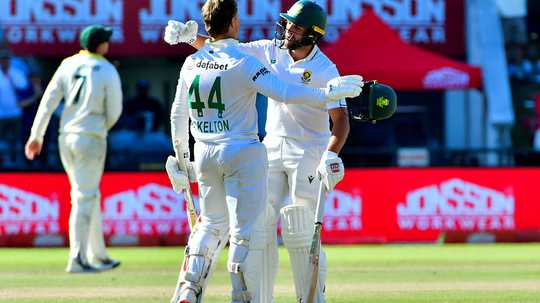
The second session brought a more noticeable shift in momentum. South Africa added 92 runs in 28 overs, and Mulder reached a half-century—his first since his remarkable triple-century against Zimbabwe. Rickelton also moved closer to a landmark hundred, keeping his composure as Australia searched for a mistake.
Rickelton eventually reached three figures, a major achievement in a high-pressure innings on a difficult pitch. But the celebration was brief. After a partnership of 154 runs that had taken 318 balls and steadily strengthened South Africa’s position, a misunderstanding between the batters led to Rickelton being run out for 101.
The dismissal was a significant opening for Australia. South Africa have been vulnerable to clusters of wickets during the series, and a strong lead does not guarantee safety if the lower order is exposed. The visitors sensed an opportunity to regain control, particularly with the pitch offering Lyon increasing assistance.
Mulder’s Century Gives South Africa a Strong Lead
Mulder remained the key figure as wickets fell around him. Marco Jansen was dismissed attempting a pull shot to deep square leg, while Lyon bowled Simon Harmer to add to Australia’s progress. South Africa’s advantage had taken a blow, but Mulder stayed disciplined and continued to move the score forward.
He showed his attacking intent when he struck Lyon for four to push the lead beyond 250. Three balls later, however, another mix-up resulted in Gerald Coetzee’s run-out, adding to the sense that South Africa could still lose control of the innings. With Kagiso Rabada alongside him, Mulder looked for opportunities to score without abandoning the patience that had carried him through the day.
Mulder reached his century and then accelerated as the light began to fade. He launched a six off Cummins and soon slog-swept Lyon for another, putting further distance between the teams. His innings ended on 115 when he was caught in the deep, but by then he had helped South Africa establish a commanding lead of 287 runs.
Final-Day Cricket Prediction: Australia Face a Difficult Chase
South Africa finished their second innings on 387, having been dismissed for 329 in the first innings. Australia made 429 in reply, giving the hosts an overall lead of 287. The visitors therefore need 288 runs to win, while South Africa require ten wickets to secure the match.
The final-day outlook depends heavily on how quickly Australia’s top order can adapt to the changing surface. Lyon could become a major threat as the pitch continues to wear, but South Africa’s bowlers will also be encouraged by the uneven bounce and the pressure of a substantial chase. Australia have experienced batters capable of building a response, so the target is challenging rather than impossible.
For South Africa, the priority will be to make the new day feel difficult from the first over: bowl accurately, create doubt and avoid giving Australia easy scoring options. For Australia, a steady start could shift the pressure back onto the hosts. With the series already marked by dramatic momentum swings, the final-day cricket prediction remains uncertain—but South Africa have earned the stronger position.
Brief Scores
South Africa: 329 and 387 (Wiaan Mulder 115, Ryan Rickelton 101; Mitchell Starc 3/65, Pat Cummins 2/71).
Australia: 429. South Africa lead by 287 runs and have set Australia a target of 288.