
Ballon d’Or History Reconsidered: A New Study Ranks Football’s Most Influential Players, Clubs and Nations
The Ballon d’Or is usually remembered through its winners: the players who lifted football’s most celebrated individual prize and defined a season. But a new statistical study asks a broader question: what does the award’s history look like when every high finish counts, not just first place?
By converting players’ positions in the annual vote into cumulative points, researcher Santi García Cremades has produced a fresh prediction-free historical ranking of the award’s influence. The results put Real Madrid first among clubs, Germany at the top among nationalities and Cristiano Ronaldo ahead of Lionel Messi on total points. Yet Messi leads on Ballon d’Or wins and average points per appearance, showing how the answer changes with the measure used.
The analysis offers more than a new leaderboard. It traces how football’s centres of influence have shifted between clubs and countries, and reveals the difference between building a legacy around one extraordinary star and sustaining a presence through successive generations.
How the P30 system changes the Ballon d’Or comparison
The study covers 69 editions of the Ballon d’Or from 1956 to 2025, excluding 2020, when the award was not presented. It includes 2,099 player records associated with 213 clubs and 66 nationalities.
Instead of counting only victories, the researcher assigned points according to each player’s position in the vote. Under the system, called P30, first place receives 30 points, second earns 29, third gets 28, and the score continues downward. A player who repeatedly finishes near the top can therefore build a substantial total even without winning every year.
This approach measures continuity in elite football as well as peak achievement. It does not replace the traditional Ballon d’Or record, but adds another way to assess long-term prominence. A player’s total reflects how often he remained in the conversation across seasons and generations—not simply how many times he reached the top step.
Real Madrid lead the club rankings
Real Madrid top the cumulative club table with 3,189 points, ahead of Barcelona on 2,717. Juventus rank third with 2,059, followed by Bayern Munich on 2,027 and AC Milan on 1,829. Manchester United, Inter Milan, Liverpool, Ajax and Manchester City complete the top ten.
Madrid’s lead reflects a presence spanning many eras. The club featured in the award’s historical rankings across 57 editions, from the teams associated with Alfredo Di Stéfano and Raymond Kopa to the Cristiano Ronaldo era and later generations. Ronaldo contributed 261 points during his Madrid career, but that represents only 8.2% of the club’s overall total. The figure underlines how Madrid’s position was built by a succession of celebrated players rather than a single star.
Barcelona’s total is more closely connected to Messi. His points account for 14.9% of the club’s tally, a notable share that reflects his extraordinary influence during a defining period in the club’s history. The contrast is not a measure of which club is “greater” in every sense; it shows how their Ballon d’Or influence was distributed differently.
Ronaldo edges Messi on points, while Messi leads on wins
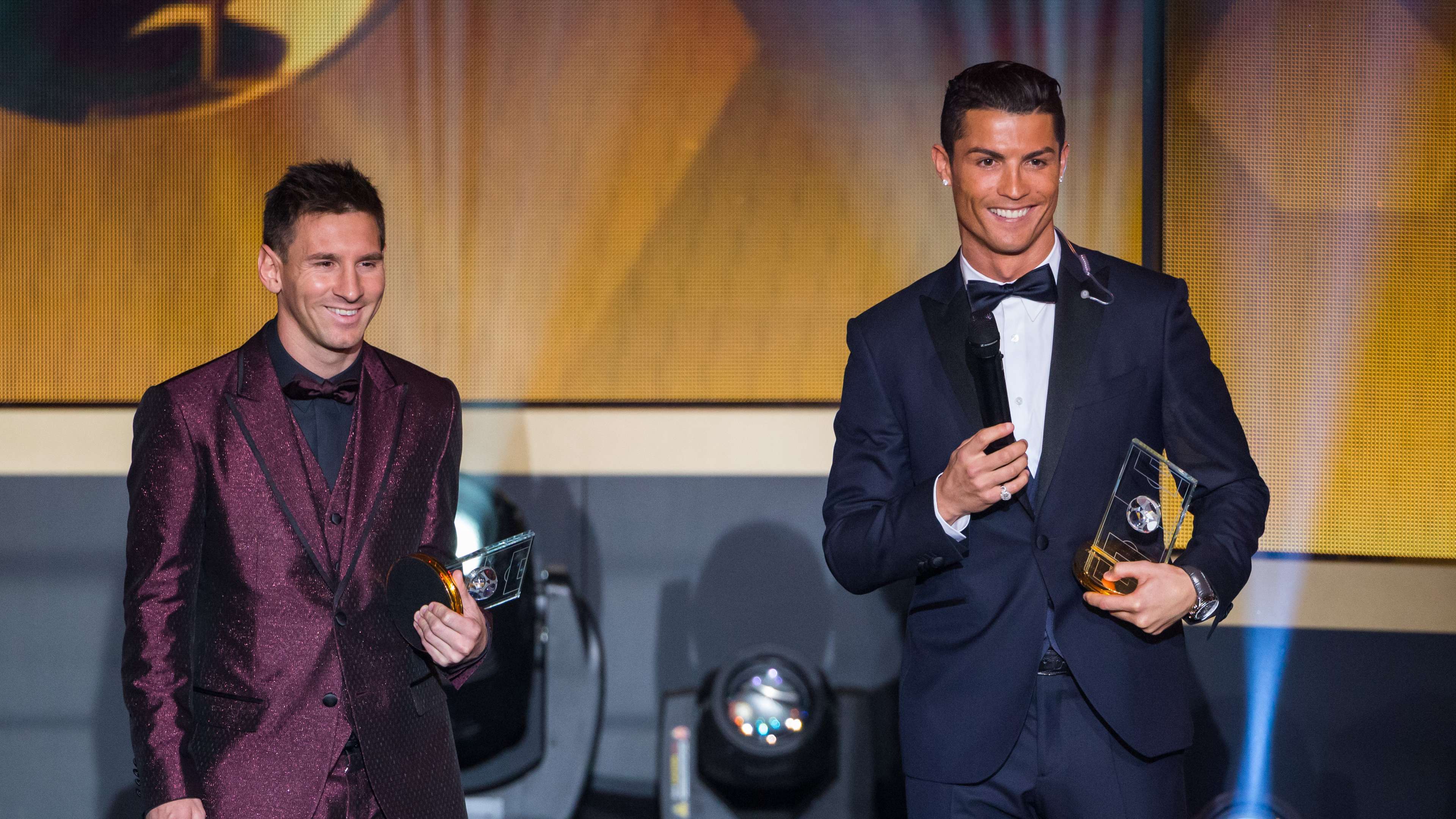
The individual comparison is remarkably close. Ronaldo finishes first in the P30 ranking with 460 points, just ten ahead of Messi’s 450. But the figures change when the focus shifts from cumulative points to trophies and average performance.
Messi has won the Ballon d’Or eight times, three more than Ronaldo, and has reached the podium 14 times compared with Ronaldo’s 12. He also has the higher average score per participation: 28.125 points to Ronaldo’s 25.556.
The distinction reflects two different forms of sustained excellence. Ronaldo’s longer period of high-level contention helps explain his edge in total points. Messi’s greater number of wins and stronger average point score show how frequently he finished at the very top. Neither statistic settles the debate over the best player; together, they demonstrate why any football prediction or historical verdict depends on the criteria being used.
Germany’s depth puts it first among nationalities
Germany leads the nationality ranking with 3,854 points. Italy follows on 3,229, France has 2,976, England 2,821 and Spain 2,551. These totals reflect the long-running influence of European football, as well as the ability of several countries to produce award contenders across multiple generations.
Germany’s biggest individual contributor accounts for only 8.3% of the country’s total, while Italy’s leading player represents 6.9%. Both figures suggest that their historical standing is spread across a broad group of stars. Portugal and Argentina show a different pattern: Ronaldo accounts for 29.9% of Portugal’s points, while Messi represents 44.5% of Argentina’s total.
That contrast reveals two routes to a lasting statistical presence. Some nations build their record through depth and a steady succession of prominent players; others receive a much larger share of their total from an exceptional individual.
Football’s centres of power changed with each era
The club leaders also changed over time. Real Madrid dominated the award’s opening years from 1956 to 1959. Manchester United led the 1960s, Bayern Munich topped the 1970s and Juventus took the 1980s. AC Milan led in the 1990s, before Real Madrid returned to the top in the 2000s with 649 points.
Barcelona’s strongest period came between 2010 and 2019, when the club collected 930 points—the highest total recorded by any club in any period covered by the study. The result reflects the club’s sustained presence among the leading candidates during Messi’s peak years. Real Madrid led again from 2021 to 2025, illustrating how dominance can shift as squads and generations change.
National leaders followed their own timeline: Hungary topped the opening period, Italy led in the 1960s, Germany in the 1970s and 1980s, and Italy returned to first place in the 1990s. Brazil led from 2000 to 2009, Spain from 2010 to 2019, and France in the most recent period examined.
One superstar or generations of influence?
The study also measures how heavily clubs rely on their leading individual contributor. Eusébio accounts for 53.8% of Benfica’s Ballon d’Or points, making him the clearest example of a single player shaping a club’s statistical legacy. Thierry Henry represents 31.6% of Arsenal’s total, while Kylian Mbappé accounts for 24.7% of Paris Saint-Germain’s and Kevin De Bruyne 21.1% of Manchester City’s.
By comparison, no player contributes more than 8.2% of Real Madrid’s total or 8.1% of Juventus’s. Manchester United’s leading contributor, Bobby Charlton, represents 12.7%. These differences point to contrasting models of influence: a club may be strongly associated with one transformative figure, or its record may grow through a long line of prominent players.
Connections between clubs and nationalities offer another perspective. German players account for 75.1% of Bayern Munich’s total, while Dutch players make up 73.6% of Ajax’s. Real Madrid and Barcelona together contribute nearly three-quarters of the points earned by Spanish players. Barcelona also has a striking link to Argentina: players who represented the club account for 42.9% of the country’s total points.
What the study can—and cannot—tell us
Across an average Ballon d’Or edition, the four highest-ranked clubs collect half of the available points, while the top four nationalities receive 57.7%. That concentration was especially pronounced in some years, including 2010, 2014 and 2015 for clubs, and 1974, 1982 and 1990 for nationalities.
These figures describe representation in the Ballon d’Or vote, not trophies won, team performance or a definitive ranking of football’s greatest players. The P30 method rewards sustained visibility in the award’s results, making it a useful complement to traditional comparisons rather than a final verdict.
Its central insight is that footballing greatness can be measured in more than one way. Winning the Ballon d’Or captures a season of individual achievement; remaining near the summit over many years tells a broader story of consistency, influence and changing generations. On that wider measure, Real Madrid and Germany lead, Ronaldo edges Messi on cumulative points, and Messi retains the advantage in wins and average score—proof that the history of the Ballon d’Or is richer than a list of winners alone.