
VAR Review Backs Barcelona Handball Decision in Real Betis Clash
A contentious handball decision during Barcelona’s meeting with Real Betis in the ninth round of the Spanish league has drawn fresh scrutiny, with refereeing analysis outlet Archivo VAR concluding that the officials were right to penalise the incident. The site said the decisive factor was the position of the player’s arm when the ball struck it—not whether the contact changed the ball’s path or affected possession.
The ruling became one of the match’s major talking points, alongside a separate dispute over Real Betis’ equaliser. Together, the incidents have renewed debate about how football’s handball and physical-contact rules are interpreted, and what supporters should expect from VAR in close calls.
Why the handball was considered punishable
According to Archivo VAR, the player’s arm was in an unnatural position at the moment of impact. Under the handball criteria applied by match officials, that can be enough to make the contact an offence. The assessment does not hinge on whether the ball’s trajectory changed noticeably or whether the player gained control as a result.
Instead, the key question is whether the arm’s position was justifiable in the circumstances. If it makes the player’s body unnaturally larger, officials may judge that the player has taken an avoidable risk. That distinction can be difficult for viewers to assess in real time, particularly when a ball arrives at close range and replays show only a brief moment of contact.
Former referee Iturralde González, who discusses officiating decisions for Spanish radio station Cadena SER, also supported the decision to disallow the goal. He explained that the handball occurred during the same attacking move that led directly to the finish. Under the instructions in force, a goal cannot stand when the attacking team commits a handball offence in the build-up to scoring.
The timing of the offence matters. A handball by an attacker is not treated in exactly the same way in every phase of play; officials must consider whether it occurred as part of the immediate scoring action. In this case, the analysis cited by González placed the contact within the attack that produced the goal, supporting the referee’s decision to rule it out.
Betis equaliser prompts a second refereeing debate
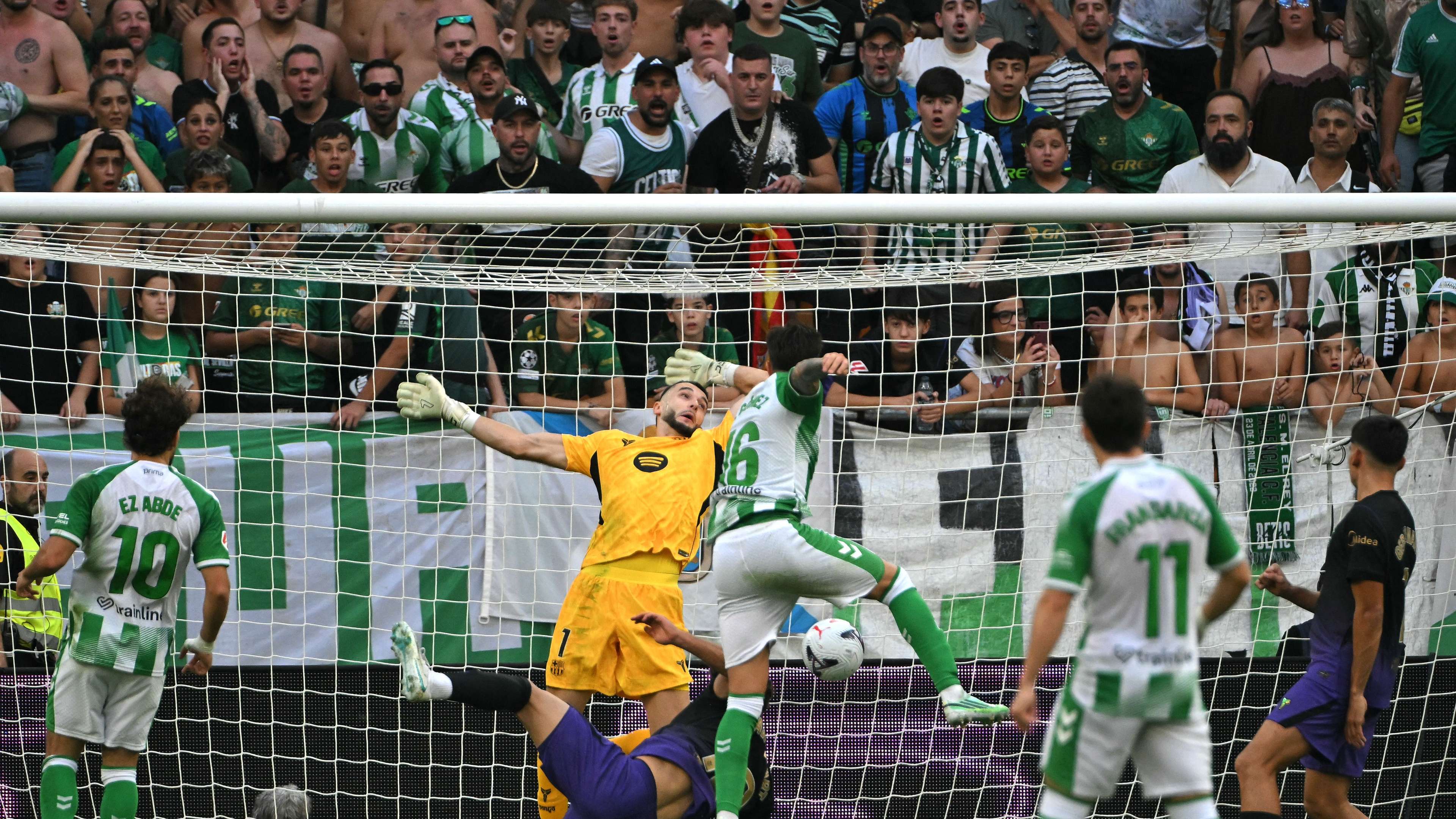
The handball was not the only incident to frustrate Barcelona supporters. Real Betis drew level in the 27th minute when defender Valentín Gómez rose inside the six-yard box to meet a cross and headed home. Barcelona’s defence had been unable to clear the corner effectively, giving Betis an opportunity to attack the loose delivery.
Replays then showed contact between Gómez’s arm and the back of Xavi Espart as both players went up for the ball. Some Barcelona fans argued that the contact amounted to a push and should have resulted in a foul before the header. The complaint centred on whether Gómez used his arm to gain an unfair advantage, rather than simply making incidental contact while challenging in the air.
Referee De Burgos Bengoetxea allowed the goal to stand and did not go to the pitchside monitor to review the incident. That decision became another flashpoint, with supporters questioning why the contact was not treated as an offence. Jota Jordi, an analyst on the television programme El Chiringuito, said the goal should have been disallowed, describing the action as a clear push.
Why the two incidents may be judged differently
Although both moments involved contact and generated strong reactions, the relevant tests are not identical. The handball decision focused on the position of the arm when the ball struck it and on whether the contact came within the attacking move that led to a goal. The equaliser, by contrast, required the referee to decide whether the arm-to-back contact was enough to constitute a foul during an aerial challenge.
Football’s laws do not automatically make every use of an arm an offence. Referees must judge the force, timing and effect of the contact, as well as whether a player has unfairly displaced an opponent. In a crowded penalty area, players often make contact while competing for position, so officials are expected to distinguish ordinary physical play from a push that materially prevents an opponent from challenging for the ball.
That judgement helps explain why a decision can appear inconsistent to fans watching the same match. A handball may be assessed against specific criteria about arm position, while a possible push depends more heavily on the referee’s view of the contest and the degree of force involved. Slow-motion footage can clarify where contact occurred, but it can also make routine movement appear more dramatic than it looked at full speed.
What VAR can—and cannot—settle
VAR is designed to intervene in clear and obvious errors involving goals, penalties, direct red cards and mistaken identity. It is not intended to replace the on-field referee’s judgement every time a replay reveals contact. If the video officials believe the referee’s interpretation falls within an acceptable range, they may decide that a review is not warranted.
That threshold is central to understanding why De Burgos Bengoetxea did not review the Betis goal. The absence of a pitchside check does not necessarily mean the contact was overlooked; it may indicate that the VAR team did not consider the decision a clear error. Still, limited explanations during a match can leave supporters uncertain about what was checked and why intervention was rejected.
For clubs, players and fans, greater clarity around VAR decisions remains an important issue. Brief public explanations can help show whether officials focused on the arm’s position, the force of a challenge or the connection between an offence and a goal. Without that context, each disputed moment risks becoming a debate shaped more by team loyalties than by the laws of the game.
What the controversy means for the wider title race
The match’s refereeing arguments are likely to remain part of the post-game discussion, but they also underline how small decisions can influence the rhythm of a league contest. A disallowed goal can change a team’s approach, while a contested equaliser may affect momentum and the pressure placed on both defences. That does not, by itself, establish that an outcome was unfair; it shows why accurate and consistent officiating matters in high-stakes football.
Any prediction about the wider consequences should be treated cautiously. One match does not determine a season, and teams still have to convert chances, defend set pieces and respond to setbacks over many rounds. For Barcelona, the immediate lesson is the importance of managing defensive situations in the box, especially after corners. For Betis, Gómez’s well-timed run demonstrated the value of attacking a delivery decisively.
Archivo VAR’s assessment offers a clear conclusion on the handball: the offence was correctly given because of the unnatural arm position, with the same-attack rule providing an additional reason for the goal to be cancelled. The Betis equaliser remains more open to interpretation, as the referee judged the contact insufficient for a foul while critics—including Jota Jordi—believed it crossed the line. The contrasting decisions capture a familiar challenge in modern football: applying precise laws to fast, physical moments that rarely look simple from every angle.